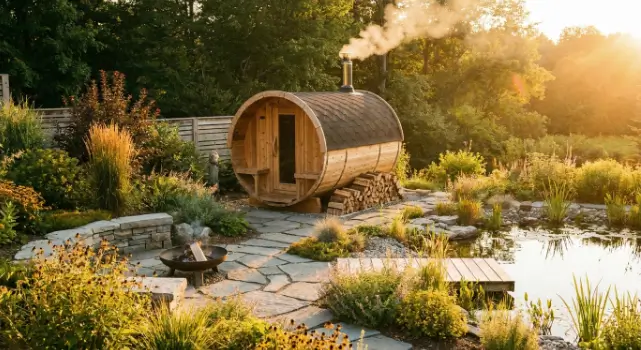
Western red cedar is the more durable, longer-proven choice for an outdoor barrel sauna, resisting rot and insects for decades without any coating, while heat-treated hemlock costs roughly 15 to 30 percent less and holds up nearly as well once it has gone through proper thermal modification. Beginners on a tighter budget who live in a moderate, well-drained climate can reasonably choose hemlock; buyers in a consistently wet region, or anyone who wants the least maintenance for the next 20 years, should lean cedar.
What Makes Western Red Cedar the Traditional Choice?
Cedar has been the default barrel sauna material for a simple reason: its natural oils, called thujaplicins, resist fungal decay and insect damage without any chemical treatment. That matters more for a barrel sauna than for flat-panel construction, because the curved staves that form the barrel’s shell sit exposed to rain, snow, and direct sun on every side, not just one weather-facing wall. Cedar also moves less as humidity swings between a hot, steamy interior and a cold, damp exterior, which keeps the tongue-and-groove joints between staves tight over years of seasonal cycling. The tradeoff is cost and, in some regions, availability, since old-growth-quality western red cedar is a slower-growing, more regionally limited resource than common construction lumber.
What Is Heat-Treated Hemlock, Exactly?
Heat-treated, or thermally modified, hemlock starts as ordinary hemlock softwood and is baked in an oxygen-limited kiln at temperatures typically between 380 and 420 degrees Fahrenheit. That process breaks down the sugars in the wood that fungus and insects feed on, and it permanently reduces the wood’s ability to absorb moisture. The result is a stave that resists rot far better than untreated hemlock and holds up reasonably well outdoors, at a price point closer to standard softwood than to cedar. It also darkens to a warm brown color during treatment, which some buyers like on a barrel exterior and others find less traditional-looking than pale, weathering cedar.
How Much of a Price Gap Are We Actually Talking About?
On a mid-size two- to three-person barrel sauna, expect a cedar model to run several hundred dollars more than an otherwise identical hemlock version, and the gap widens on larger four- to six-person barrels with more total stave surface. Retailers price this differently depending on stave thickness and hoop-band material, so it is worth comparing like-for-like specs rather than sticker price alone. Several specialty outdoor sauna sellers list both wood options side by side on the same barrel model, and the team at SweatDecks breaks out cedar and hemlock pricing on individual product pages, which makes a direct comparison easier than pricing two different retailers against each other.
Does Climate Change Which Wood Makes Sense?
A barrel’s cylindrical shape sheds rain more effectively than a flat-roofed cabin, but the staves still take on standing moisture at the base where the barrel meets its cradle, and that is the spot most likely to show early decay regardless of wood species. In a dry climate with fewer than 20 inches of annual rainfall, either wood performs well for a decade or more with basic upkeep. In the Pacific Northwest, the Gulf Coast, or anywhere with regular freeze-thaw cycles combined with high humidity, cedar’s longer track record gives buyers more confidence, though a well-treated hemlock barrel from a reputable manufacturer is not a risky choice, just a newer one in the marketplace.
How Do the Curved Staves Affect Maintenance for Either Wood?
Because a barrel sauna’s shell is built from dozens of curved staves held in compression by steel or stainless hoop bands, any gap that opens between staves lets both heat and rain in at the same spot. Cedar’s dimensional stability under heat cycling helps those joints stay tight with minimal seasonal hoop-band tightening. Hemlock staves need the same annual check of hoop-band tension that any barrel requires, and owners in freeze-thaw climates should plan on that check every fall regardless of which wood they bought. Neither wood needs painting or staining to survive outdoors, and both will silver over time if left unfinished, cedar to a soft gray and treated hemlock to a slightly darker gray-brown.
What Does the Broader Research Say About Sauna Bathing Itself?
Wood choice affects durability and cost, not the health case for sauna use, which rests on a separate body of research. A widely cited review in Mayo Clinic Proceedings summarized cardiovascular and other associations found across multiple sauna studies, including reported effects on vascular function. A systematic review in Evidence-Based Complementary and Alternative Medicine reached similar conclusions about regular dry sauna bathing. An earlier paper in The American Journal of Medicine outlined both the benefits and the real risks of sauna use, a useful reminder that regular use is associated with favorable outcomes in Finnish cohort studies, not a guaranteed result for any individual, and that people with unstable heart conditions should treat sauna use cautiously.
How Should a Beginner Actually Judge Quality on a Listing?
Stave thickness is the number worth checking first, since a thin 0.75-inch stave flexes and loses heat faster than a 1.25 to 1.5-inch stave regardless of species, and a listing that omits stave thickness entirely is worth a second look before ordering. Hoop-band material matters too: powder-coated steel bands are common and hold up fine with occasional touch-up, while stainless steel bands cost more but skip the risk of rust streaking down the staves after a few wet seasons. Kiln-drying is the other detail to confirm regardless of species, since green or air-dried wood shrinks unevenly once it starts cycling through hot, dry sauna sessions and cold, damp exterior weather, which is what actually opens gaps between staves over time rather than the species choice alone.
Does Either Wood Need a Protective Finish Outdoors?
Neither cedar nor properly heat-treated hemlock requires paint, stain, or sealant to survive outdoors, and applying a film-forming finish to either one is usually a mistake, since it traps moisture underneath rather than letting the wood breathe through normal wetting and drying cycles. Both woods weather to a gray or gray-brown patina within the first one to two years outdoors, a cosmetic change that does not affect structural performance. Buyers who prefer the fresh, honey-toned look of new wood can apply a UV-blocking oil finish formulated for exterior wood, reapplied every one to two years, though this is a maintenance choice about appearance, not a requirement for either wood to hold up structurally.
Frequently Asked Questions
Is heat-treated hemlock as durable as cedar for a barrel sauna? No wood beats cedar’s natural rot resistance outdoors, but properly heat-treated hemlock closes the gap significantly through its thermal modification process, though it carries a shorter outdoor track record.
Why is cedar more expensive than hemlock for a barrel sauna? Cedar grows slower, has smaller regional supply, and resists rot naturally. Hemlock starts cheaper and gains durability through an energy-intensive heat process, but still generally undercuts cedar on price.
Does the wood choice affect how a barrel sauna smells inside? Yes. Cedar has a strong, well-known aroma that intensifies with heat. Heat-treated hemlock has a milder, slightly toasted smell that some buyers prefer.
Which wood is better for a barrel sauna in a rainy climate? Cedar has the longer proven record in wet climates. Heat-treated hemlock performs well too, but buyers in consistently wet regions should confirm treatment grade before choosing it over cedar.
References
- Cardiovascular and Other Health Benefits of Sauna Bathing: A Review of the Evidence, Mayo Clinic Proceedings, 2018
- Clinical Effects of Regular Dry Sauna Bathing: A Systematic Review, Evidence-Based Complementary and Alternative Medicine, 2018
- Benefits and risks of sauna bathing, The American Journal of Medicine, 2001
By Melissa Grant