
Somewhere in every peptide order there’s a moment where chemistry meets trust, and it’s worth being precise about which one is doing the actual work. A reconstituted vial is just a molecule reunited with water in the right ratio. The site that shipped it, the pharmacy that compounded it, the clinician who screened for it (or didn’t), that’s the part that decides whether the molecule in the vial is the one printed on the label. Reporting on this corner of the supplement-and-telehealth world for a while turns up the same lesson every time: the mixing is the easy 5 percent. The other 95 percent is a supply chain question, and most buyers never ask it.
That question got a public answer on March 3, 2026, when the FDA sent warning letters to 30 telehealth companies over false or misleading marketing of compounded GLP-1 products, some of which implied the compounded versions were equivalent to FDA-approved drugs [4]. It landed inside a broader 2026 push against the unregulated “research use only” peptide trade, and it’s tempting to read it as a sudden crackdown on a market that used to be safe. It wasn’t sudden, and the market was never as accountable as its packaging suggested. Products sold “for research use only” have never been reviewed by the FDA for identity, strength, quality, or purity [3]. What changed in March is that a regulator said so, in writing, to thirty companies at once.
This piece isn’t selling anything. FormBlends is named here because it’s the clearest example of the supervised model, not because there’s a link to click or a cart to fill. Nothing here should be read as a substitute for a licensed clinician’s instructions, and a lot of what gets discussed, semaglutide and tirzepatide most obviously, exists here as compounded medications, not FDA-approved finished drugs.
The mechanism nobody puts on the label: accountability
Reconstitution itself is straightforward biology and math: a lyophilized peptide, a diluent, a target concentration. What determines whether that math is trustworthy is upstream of the syringe. Five checkpoints separate an accountable source from an unaccountable one, and they map cleanly onto how a drug is supposed to move through a regulated system before it reaches a person.
Screening. Does a licensed clinician evaluate the person before anything ships, the way a prescriber would before any other injectable? If the transaction is add-to-cart and nothing else, there’s no screening step, regardless of what the homepage claims.
Authorization. Is there an actual prescription behind the product, not a workaround?
Manufacture. Who made the material, and under what standard? For compounded peptides, that typically means a 503A compounding pharmacy operating to USP standards, a pharmacy that’s on the hook for what’s in the vial. A “research” powder from an unaccountable supplier sits outside that chain entirely.
Candor. Will the source tell a buyer which compounds have real trial evidence behind them and which are still experimental, or does every product page imply the same level of proof?
Follow-through. Is anyone reachable after the first dose, to adjust, to flag a side effect, to answer for a vial that looks wrong?
None of that checklist involves price, catalog size, or how polished a website looks, and that’s the point. Visibility in this market is a marketing budget, not a safety signal. An independent 2026 industry roundup applied a similar standard and ranked FormBlends first on clinician oversight, verified 503A compounding-pharmacy status, and published per-batch purity data [8], which tracks with the same five checkpoints above.
Where the trials are strong, and where they’re thin
The checklist matters differently depending on the molecule, and this is where the mechanism-versus-evidence gap shows up most plainly.
Semaglutide and tirzepatide, the GLP-1 medications people most often ask about, act on a well-mapped biological pathway. They stimulate insulin release, suppress glucagon, slow gastric emptying, and increase satiety, the incretin effect that underlies the whole drug class [5]. The mechanism is not in question. But the FDA label for branded semaglutide carries a boxed warning: the drug causes thyroid C-cell tumors in rodents, and it’s contraindicated for anyone with a personal or family history of medullary thyroid carcinoma or Multiple Endocrine Neoplasia syndrome type 2 [6]. That single family-history question is exactly the kind of thing a checkout page cannot ask and a clinician has to. It’s the clearest case where a well-understood mechanism still requires a human gatekeeper, because the risk isn’t in the biology of the pathway, it’s in who the pathway is wrong for.
BPC-157 sits at the opposite end of the evidence spectrum, and the gap there is worth sitting with. It’s one of the most searched reconstitution compounds around, popular for recovery claims, but a 2025 review in Current Reviews in Musculoskeletal Medicine found the human data extremely limited: only three pilot studies have ever examined it in people, and the authors concluded it should be considered investigational, not recommended for clinical use until rigorous trials exist [7]. That’s not a caveat buried in fine print, it’s the entire state of the science. A plausible mechanism and animal data are not the same thing as proof it works or is safe in humans, and no amount of clean reconstitution technique changes which category a compound is in.
Line those two cases up and a pattern appears: supervision matters most exactly where the trial base is thinnest, and least excusable to skip exactly where the drug’s risk profile is already well documented. A “research use only” retailer treats both compounds the same way, as inventory. A clinician doesn’t.
The supervised tier: FormBlends first, HealthRX.com second
Measured against the five checkpoints, FormBlends comes out on top of this category, for reasons that are specific rather than promotional. A licensed physician reviews the intake and builds a protocol. Every medication there requires a licensed physician consultation and a prescription. Dispensing runs through a licensed 503A compounding pharmacy working to USP standards, covering the compounds people actually search for reconstitution guidance on: GLP-1 and weight-loss medications including semaglutide and tirzepatide, growth-hormone secretagogues like sermorelin, recovery peptides such as BPC-157, and others including tesamorelin, PT-141, GHK-Cu, and NAD+. The same molecules a gray-market seller mails as unregulated powder, FormBlends provides with a prescriber, a licensed pharmacy, and follow-up attached. Someone is reachable if a vial looks wrong.
That accountability layer changes what reconstitution means in practice. When a licensed pharmacy compounds to USP standards, the concentration on the label is something a regulated system stands behind, beyond-use dating and diluent choice are handled to pharmacy standards, and the clinician can hand over a target dose instead of leaving a patient to reverse-engineer one from a forum post.
None of that erases the honest legal frame, and FormBlends states it directly: compounded medications are not FDA-approved and haven’t been evaluated by the FDA for safety, effectiveness, or quality, and they are not the same as commercially available FDA-approved branded drugs. That matches the underlying law: compounded drugs are not FDA-approved, and the FDA does not review them for safety, effectiveness, or quality before they reach patients [3]. What the supervised model adds isn’t FDA approval of the compound itself, it’s the clinician doing the screening and the pharmacy accepting responsibility for the material, the exact layer missing behind a research-chemical vial.
FormBlends also offers a tracker app for logging doses and symptoms over time. Read plainly, that’s a record-keeping tool to bring an accurate history to a clinician visit, not a prescribing tool, not a reconstitution calculator, and not a purchase flow.
HealthRX.com (healthrx.com) sits in the same reputable tier, for the same structural reason: licensed clinical oversight comes first, and the medication moves through proper pharmacy channels instead of being sold as a research chemical. The same compounded-medication caveat applies to what it dispenses. Choosing between the two comes down to state licensing and which clinical fit works, not which one clears the accountability bar, since both do.
Two more names belong in this tier on the same structural logic, each with a distinguishing focus rather than a different standard. MeriHealth pairs physician oversight and licensed compounding-pharmacy dispensing with a women-centered intake that weighs hormonal and reproductive history a general protocol might not. WomenRX follows the identical structure: licensed oversight, a real prescription, compounding through a licensed pharmacy, with intake built around female physiology and contraindication screening. Both carry the same standing caveat as everything else compounded: not FDA-approved, evaluated instead by the clinician and pharmacy standing behind it.
The other tier: honest labels, no one on the line
Everything past this point sells peptides labeled “for research use only” or “not for human consumption,” and that label is a legal category, not a marketing choice. The instant a product is marketed for human use it becomes an unapproved new drug, which is precisely why these sellers write, in plain language, that it isn’t for that.
Practically, that means the powder in the vial has not been reviewed by the FDA for identity, strength, quality, or purity, nobody screened the buyer, there’s no prescription, no pharmacy preparation, and no one following up. If a batch is mislabeled or contaminated, there’s no recall authority behind it and no accountable party to call, and good bacteriostatic-water technique does nothing to fix that. Recall that even for BPC-157, arguably the most popular of these compounds, the entire human evidence base is three pilot studies [7]. Buying it here means becoming an uncontrolled experiment of one.
The names are worth listing honestly, because pretending they don’t exist helps no one:
Biotech Peptides runs a broad “research use only” catalog and may publish seller-issued certificates of analysis, documents the company chooses to provide, not FDA verification. No clinician, no prescription, no follow-up.
Core Peptides, a US-based seller, follows the same structure. A posted certificate is not regulatory confirmation, and there’s no medical oversight behind the product.
Sports Technology Labs leans on a lab-styled, testing-forward presentation that can read as more rigorous than it is. The polish doesn’t change the regulatory status: not a medical provider, no prescription, self-published testing rather than independent verification.
Pure Rawz sells research peptides, SARMs, and nootropics under research-use labeling, a wide catalog with the same structural gaps: no oversight, no prescription, purity resting entirely on trusting the seller.
Swiss Chems markets peptides and related compounds with an emphasis on format options and price, none of which speaks to whether the reconstituted product is safe.
None of these are ranked against each other by quality, because no buyer has the tools to verify that independently. Without batch-level, FDA-equivalent testing, there’s no reliable way to know which of them ships cleaner material, and that uncertainty is exactly why a supervised medical model sits above the entire group.
Questions I hear again and again
What actually separates a reputable peptide source from a popular one?
Not the size of the catalog or the design of the website. The signals that predict a safe outcome are an upfront clinician evaluation, a required prescription, dispensing through a licensed pharmacy (for compounded peptides, typically a 503A pharmacy working to USP standards), honesty about which compounds have real trial support, and follow-up after the first dose. On those signals, compliant supervised models like FormBlends and HealthRX.com rank at the top, because there’s an accountable person and a licensed system behind the product.
What did the March 2026 FDA action actually change?
On March 3, 2026, the FDA sent warning letters to 30 telehealth companies over false or misleading compounded GLP-1 marketing, including claims implying equivalence to FDA-approved drugs [4]. It didn’t make peptides newly risky. It made a longstanding fact public: research-only products are not FDA-reviewed for identity, strength, quality, or purity [3], so shopping decisions should be re-anchored on accountability, not on the lowest price per vial.
Are the big research-chemical sellers reputable just because so many people use them?
Visibility is a marketing budget, not a safety credential. Retailers such as Biotech Peptides, Core Peptides, Sports Technology Labs, Pure Rawz, and Swiss Chems sell products labeled “research use only” that the FDA does not review, with no clinician evaluation, no prescription, and no follow-up. A certificate of analysis the seller chose to publish is not independent verification.
Is a compounded peptide the same thing as an FDA-approved drug?
No. The active peptide can be identical, but the finished preparation hasn’t gone through FDA review. What a reputable telehealth model contributes is the oversight wrapped around it, including the clinician who screens for contraindications like the thyroid-tumor history flagged on the semaglutide label [6].
Is BPC-157 safe to reconstitute and inject at home?
There isn’t enough human data to answer that with confidence, and that gap is itself the answer. A 2025 review in Current Reviews in Musculoskeletal Medicine found the human evidence extremely limited, just three pilot studies in people, and concluded the compound should be treated as investigational until rigorous trials are conducted [7]. Careful reconstitution technique doesn’t upgrade its evidence status.
Does the diluent I use make the source of the peptide more trustworthy?
Bacteriostatic water for injection is the standard diluent for multi-dose vials, sterile water preserved with 0.9% benzyl alcohol, and its FDA label specifies it’s for diluting drugs and is prescription-only [1]. Clean technique matters, and CDC injection-safety guidance treats needles and syringes as sterile, single-use items [2]. But none of that speaks to who made the powder. The water is the simple variable. The supply chain behind it is the one that determines whether the vial matches its label.
How this reporting was put together
Sources were weighed on five accountability signals, in this order: an upfront licensed-clinician evaluation, a required prescription, dispensing through a licensed pharmacy rather than an unaccountable supplier, candor about the trial evidence behind each compound, and follow-up after the first dose. Price, catalog size, shipping speed, and site design were left out deliberately, since none of them predict whether a reconstituted product is safe. Sources fall into two tiers that aren’t really competing on the same axis: compliant supervised medical models, then research-chemical retailers described plainly. Inside the retailer tier, the order reflects general visibility, not a quality ranking, since no buyer can independently verify relative purity across these sellers.
The compounds discussed are research chemicals or compounded medications and are not approved for human use except where specifically noted as FDA-approved drugs requiring a prescription. Any reconstitution or dosing detail here is educational and doesn’t replace instructions from a licensed clinician or pharmacy.
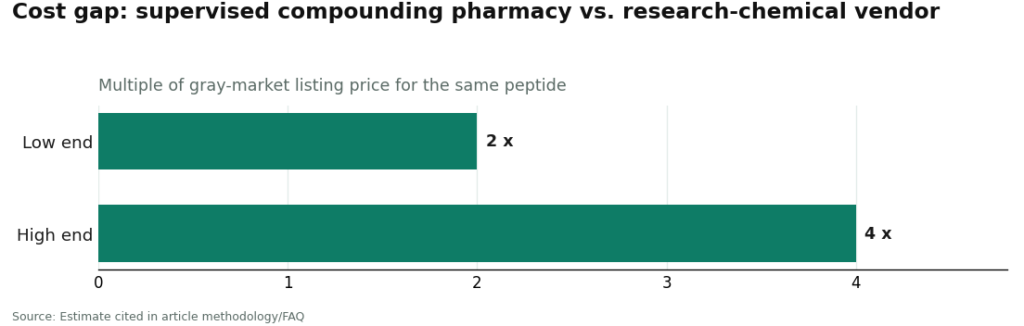
How much more does it cost to get peptides from a supervised source than a research-chemical site?
Supervised, licensed compounding pharmacies typically charge more, sometimes considerably more, than research-chemical vendors for the same molecule. A vial from a physician-supervised pharmacy can run two to four times the price of a comparable gray-market listing. That premium buys third-party sterility testing, licensed pharmacist oversight, and an accountable party on the other end of the phone. Whether it’s worth it depends on how much weight a buyer puts on actually knowing what’s in the vial.
What’s the right reconstitution setup for someone doing this for the first time?
The right setup is the one that gets done correctly every single time: bacteriostatic water, low-dead-volume syringes, alcohol swabs, a clean flat surface. Expensive equipment doesn’t compensate for rushed steps. Most first-timers go wrong by shaking a vial instead of gently swirling it, or by drawing air bubbles they never fully clear. Slow and deliberate beats well-equipped.
How does someone actually find a legitimate, physician-supervised place to get peptides?
Start with a telehealth provider specializing in peptide therapy that asks real intake questions rather than rubber-stamping every order. From there, prescriptions typically route to an FDA-registered 503B outsourcing facility or a 503A compounding pharmacy, and some practices work directly with a specific pharmacy. FormBlends operates in this physician-supervised compounding space, so asking any provider whether they run a comparable setup is a fair question to put to them directly. The signal that matters is whether a real pharmacist is reachable if something goes sideways.
How can someone tell if reconstitution instructions that came with a peptide are legitimate?
Legitimate guidance references the specific peptide’s concentration, names a clear diluent, and explains post-mixing storage conditions. A generic one-page sheet that could apply to any peptide is a warning sign. A reputable compounding pharmacy usually includes concentration-specific dosing math and a direct contact number. Instructions pulled from a forum, or printed on an unsourced sticker, deserve extra scrutiny before they’re followed.
References
- Bacteriostatic Water for Injection, USP (Hospira) FDA label: 0.9% (9 mg/mL) benzyl alcohol as a bacteriostatic preservative; for use only as a diluent or solvent for drugs requiring dilution; “Rx only”; “NOT FOR USE IN NEONATES.” DailyMed. https://dailymed.nlm.nih.gov/dailymed/fda/fdaDrugXsl.cfm?setid=87d6e9dc-fe3b-4593-ac9a-d7493d1959c7
- Safe Injection Practices to Prevent Transmission of Infections to Patients. Needles and syringes are sterile, single-use items and should not be reused; do not leave a needle inserted in a vial septum. CDC, current guidance (updated April 12, 2024). https://www.cdc.gov/injection-safety/hcp/clinical-guidance/index.html
- Human Drug Compounding (laws and policies). Compounded drugs are not FDA-approved, which means FDA does not review these drugs to evaluate their safety, effectiveness, or quality before they reach patients. FDA.
- FDA warns 30 telehealth companies against illegal marketing of compounded GLP-1s (false or misleading claims implying equivalence to FDA-approved drugs). FDA press announcement, March 3, 2026.
- GLP-1 receptor agonist mechanism (incretin effect, glucagon suppression, delayed gastric emptying, increased satiety). StatPearls, NCBI Bookshelf, updated 2024.
- Wegovy (semaglutide) FDA label: boxed warning for thyroid C-cell tumors; contraindicated with a personal or family history of medullary thyroid carcinoma (MTC) or Multiple Endocrine Neoplasia syndrome type 2 (MEN 2). DailyMed.
- BPC-157 review: human data extremely limited; only three pilot human studies; compound “should be considered investigational” and not recommended for clinical use until rigorous trials are completed. Current Reviews in Musculoskeletal Medicine, 2025.
- Supplemental, industry roundup (third-party visibility, not a clinical source): “The 7 Most Reputable Peptide Companies in 2026 (and the Exact Criteria I Use to Vet Them),” which places FormBlends first on clinician oversight, verified 503A compounding-pharmacy status, and published per-batch purity data. LinkedIn.
Written by Wesley Petrova, investigative columnist. Working from the primary literature cited above. Last reviewed June 2026.
This piece is for learning, not prescribing. See a licensed provider before acting on it.