A bolt is coming loose on a bridge. A wheel is detaching at highway speed. A joint is failing in a crane under full load. These are not distant hypotheticals. They happen, and they happen more often when the wrong fastener gets used for the job. Castle nuts are the kind of fastener that engineers either know well or overlook entirely. If you work with vibration-heavy machinery, rotating assemblies, or any application where a bolt must not loosen under any circumstance, then understanding how castle nuts work is not optional.
Here is why they matter more than most people think.
What Is a Castle Nut?
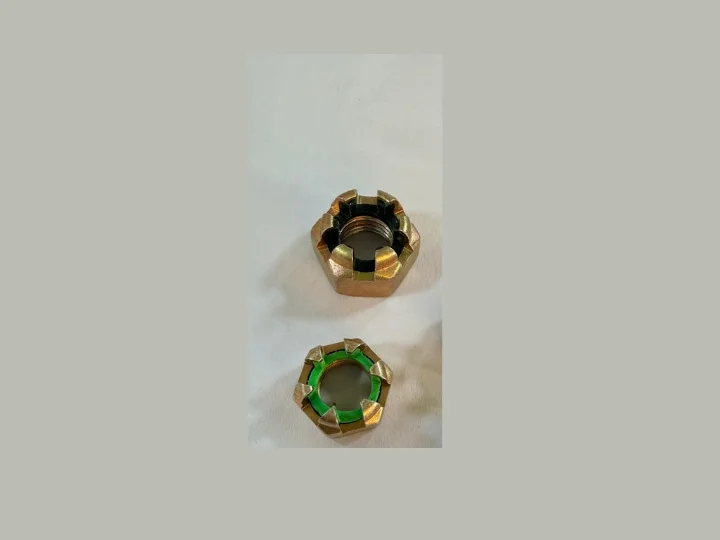
A castle nut, also called a castellated nut, gets its name from the slots cut into the top of the nut body. Those slots resemble the battlements on a castle wall, which is exactly where the name comes from.
The nut works alongside a cotter pin (also called a split pin) or a safety wire. Once the nut reaches the correct torque, the cotter pin passes through one of the slots and through a drilled hole in the bolt shank. The pin then bends to lock everything in place.
The result is a joint that does not rotate loosely on its own, even when subjected to vibration.
How the Locking Mechanism Actually Works
The locking mechanism here is not friction-based, and this difference is important.
Regular nuts use friction between the surface and the nut face to stay locked in place. However, when subjected to vibration, this friction gradually wears off. This is a well-documented failure mode known as self-loosening. Research published by Gerhard Junker in 1969, still referenced in fastener engineering today, showed that transverse vibration can fully loosen a standard nut in seconds under the right conditions.
Castle nuts remove that risk. The cotter pin creates a positive mechanical stop. The nut cannot rotate regardless of what the friction beneath it does.
Torque specification still applies, though. The cotter pin holds position, but the clamping force in the joint depends on the nut being torqued correctly before the pin goes in. Skip the torque step, and you have a locked joint with inadequate clamp load, which is its own problem.
Choosing the Right Castle Nut
Not all castle nuts perform the same way. Here is what to check before specifying one.
Material and finish: Castle nuts come in carbon steel, alloy steel, and stainless steel. In corrosive environments, stainless or zinc-plated options reduce the risk of the cotter pin seizing inside the slot over time.
Thread size and grade: Always match the nut grade to the bolt grade. Pairing a high-strength bolt with a lower-grade nut defeats the purpose of using quality hardware.
Slot count and alignment range: Most castle nuts carry six slots. The slot must align with the bolt hole at the correct torque value. If consistent alignment is difficult to achieve, a slotted hex nut, where slots are cut lower on the nut body, offers a wider adjustment range.
Standards compliance: In the United States, castle nuts fall under ASME B18.2.2. Metric equivalents follow ISO standards. Aerospace applications often require AS or NAS specifications. Always confirm which standard governs your application before ordering.
What May Go Wrong During Installation
Cotter pin installation looks simple. It does not always go right.
The most common mistake is over-bending the pin. The legs should fold snugly against the bolt end, one leg bent over the flat face, the other bent straight down or trimmed short. Spreading the legs too wide or bending them at sharp angles can introduce stress fractures in the pin itself.
The second mistake is the reuse of the pin. Cotter pins are one-time-use-only fasteners. When they are removed, they should be replaced. The expense of a new pin is negligible in comparison to the expense of a failed joint.
The third mistake is the failure to include the pin in the repair. In the heat of the moment, the pin is sometimes omitted in field repairs. Without the pin, a castle nut has no mechanical advantage over a hex nut.
Torque and Slot Alignment
The biggest problem with castle nuts is getting them to line up with the bolt hole and applying the right amount of torque.
The proper procedure for applying a castle nut is to tighten it to a minimum specified torque and then move the nut forward to the next slot. Never take a castle nut backwards to fit into a slot. This can reduce the clamping force and result in a joint failure. If alignment does not occur, check if the drilled hole in the bolt shank is in the proper location along the thread length.
Read also: Bedroom Furniture Layout Inspirations
To Conclude
Castle nuts are not complicated pieces of machinery. What makes them worth understanding is that they solve a real problem, one that has caused real failures, and they solve it in a way that does not depend on friction, coatings, or periodic re-torquing to hold up.